Wednesday, 10 February 2016

FOUR SIMPLE VEGGIES IN MY HUMBLE KITCHEN


Here are four more regular veggies from the kitchen of Bengal, also family recipes. Still on a tour of nostalgia, I strongly feel the urge to compile such recipes which have the threat to be forgotten soon. One of the main inspiration behind this is off course Piyali Mutha of My Tryst With Food and Travel fame whose blog is a storehouse of Indian, International recipes along with her travel experiences around the world. Latest in her blog is an awesome Bengali Vegetarian Thali, where every details of Bengali life and culture is captured, indicating we need to preserve them. For the food lovers, her blog link is @ mytrystwithfoodandtravel.blogspot.com

Drawing inspiration from such posts, I am making a humble effort to compile what is getting lost. I am sharing them everywhere, even amidst the people to whom such dishes are like strangers, anyone stopping by means my culture & food reached a little further. Therein lies my satisfaction.

These are simple veggies that are / were been cooked in the Bengali homes. I get drenched with many a memories when it comes to such dishes. How beautifully the ladies of the house cooked them, who never knew or bothered about showcasing their talents.

I remember my senior's grandma, a super active lady in her 80's some 18-20 years back cooked wonderful vegetarian dishes with minimal ingredients and in a small stove. I am just trying to keep them alive. 

Hopefully the future generation will try them besides their '2 minutes dinner menus'. Here I compiled together 4 Bengali vegetarian dishes which we will cook together now.

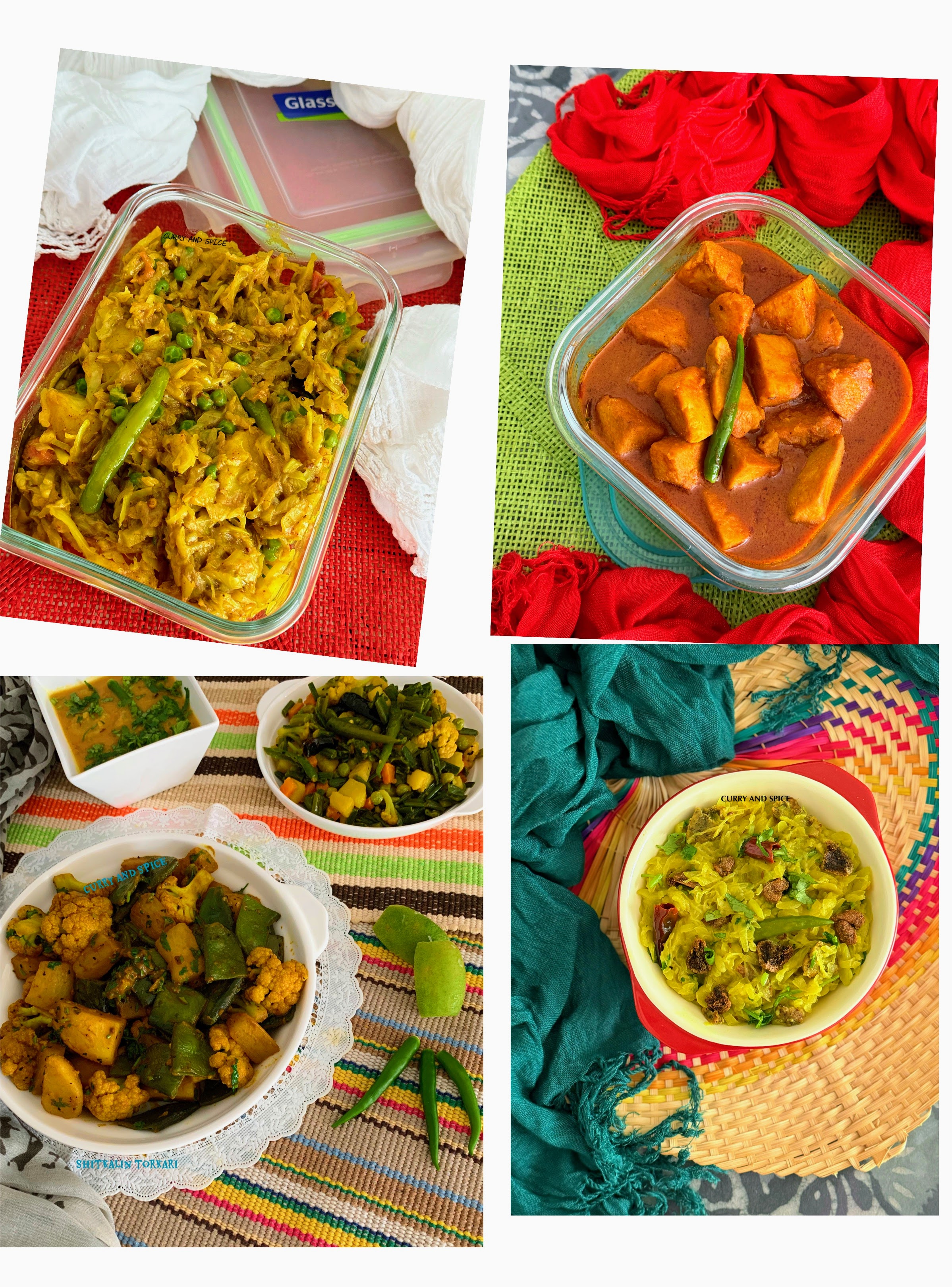
      BADHAKOPIR GHONTO /  CABBAGE WITH POTATOES


INGREDIENTS :

Cabbage : 1 small sized
Potato : 1big
Tomato : 1medium
Green Pea : 1/2small cup
Green Chilli : 2[slitted]
Dry Red Chilli : 1[halved]
Ginger Paste : 1tsp
Cumin Powder : 1/2tsp
Turmeric Powder : 1tsp
Cinnamon Powder : 2pinches
Cardamom Powder : 1pinch
Cloves Powder : 1pinch
Cumin Seeds : 2pinches
Bayleaf : 1
Sugar : 1tsp
Salt : As required
Ghee[clarified butter] : 1tsp [skip to make it vegan]
Oil : 3tbsp

METHOD : 

Shred the cabbage, add enough water and a little of salt. Microwave at high for 5-6 minutes. Strain the water.

Wash and chop the tomato. Peel, wash and cut the potato into 8 pieces. Rub with salt and turmeric.

Heat the oil in a wok. Lightly fry the potato pieces. Take out and keep aside.

Temper the remaining oil with cumin seeds, bayleaf and the halved dry red chilli. Add the ginger paste, salt and turmeric. Stir for a minute. Add the cabbage, stir and cover. Remove the cover and stir every 3-4 minutes.

You will see a lot of water releasing. When about 75% of water would dry up, add the tomato pieces, fried potato pieces, cumin powder, slitted green chillies. Stir and cover cook for 3-4 minutes.

Remove the cover, add the sugar, green peas, cinnamon, cardamom and cloves powder. Stir and cover cook for 2-3 minutes.Remove the cover, garnish with ghee. Switch off the burner!

It goes well with both rice / roti.    

OLER DALNA / YAM CURRY


INGREDIENTS :

Ol[suran/elephant foot yam] : 250gm
Ginger Paste : 2tsp
Cumin Powder : 1tsp
Coriander Powder : 1/2tsp
Red Chilli Powder : 1tsp
Turmeric Powder : 1tsp
Cinnamon Powder : 2pinches
Cardamom Powder : 1pinch
Cloves Powder : 1pinch
Cumin Seed : 2pinches
Salt : As Required
Bayleaf : 1
Ghee : 1tsp [skip to make it vegan]
Oil : 2tsp

METHOD :

Peel & cut the big chunk of yum into small cubes. Wash them and rub with salt and turmeric.

Heat the oil in a wok. Fry the yam pieces in batches. Take out and keep aside.

Temper the same oil with a bayleaf and cumin seeds. Add the ginger paste and fry for 1-2 minutes.

Add the cumin powder, salt, turmeric, coriander powder, chilli powder. Saute for 1/2 a minute. Add the fried pieces of yum. Fold in well and stir for a minute.

Add a cup of water, boil for 3-5 minutes. Add the cinnamon, cardamom, cloves powder, ghee and cook for another minute.

Serve hot with steamed rice.   

MORSHUMI TARKARI / SEASONAL VEGGIES


INGREDIENTS :

Cauliflower : 1medium
Long Bean : 3-4
Hyacinth Bean : 150gm
Radish : 2small
Potato : 2 medium
Coriander Leaves : 2sprig
Green Chilli : 2[slitted]
Dry Red Chilli : 1[halved]
Turmeric Powder : 1tsp
Nigella Seed[kalonji] : 1/4tsp
Salt : As Required
Sugar : 1tsp
Oil : 2tbsp

METHOD :

It is called seasonal because in those days cauliflower and Hyacinth beans were available only in winter. 

Cut the cauliflower into medium sized florets. The long beans and radish should be cut lengthwise. Discard the skin of the radish. Cut half each of the Hyacinth beans. Peel and cut the potatoes into big cubes.

Wash the vegetables and rub with salt and turmeric. Keep aside for 15 minutes.

Heat the oil in a wok, temper with the kalonji / kalojeere and the halved dry red chilli. Add the radish first, cover cook for 3-4 minutes. Add the potatoes & long beans now, stir and cover cook for 3-4 minutes. Keep the heat at minimal. Remove the cover and add the broad beans and cauliflower florets. Stir and cover cook at minimal heat for 7-8 minutes.

Add the sugar and slitted green chillies. Stir and cook for another minute. Wash and chop the coriander leaves. Add to the veggies. Stir cook for 1/2 a minute and switch off the gas stove.

It goes well with both rice/roti.

LAU GHONTO / BOTTLE GOURD BENGALI STYLE


INGREDIENTS :

Lau[bottle gourd] : 1medium sized
Bori[dried lentil balls] : 7-8[you may skip]
Green Chilli : 2[slitted]
Coriander Leaves : 3sprigs
Cumin Seed : 1/4tsp
Bayleaf : 1
Dry Red Chilli : 2[halved]
Turmeric Powder : 1/2tsp
Salt : As Required
Oil : 2tbsp

METHOD :

Peel and wash the the bottle gourd. Cut into smaller pieces and shred.Discard the bigger seeds, in fact younger ones while buying.

Heat the oil in a wok and fry the lentil balls if using. Keep aside.

Temper the oil with cumin seeds and bayleaf, dry red chillies.

Add the shredded bottle gourd. Add salt. Stir and cover. It will release a lot of water.

Once it is 60-70% done, add the turmeric powder, slitted green chillies. Stir and cover again.

Once the water dries up completely; add the sugar, chopped coriander leaves and the fried bori broken into halves. Stir and let cook for another 1-2 minutes.

Serve with steamed rice.


Monday, 8 February 2016

RAW JACKFRUIT KOFTA CURRY / ECHORER KOFTA JHOL


Jackfruit... when raw we call it 'echor' and when ripe it is called 'kathal'. In my parental home, it is loved too much both ways. During the months of May- July, it is found in abundance at my native place. In this island too it is popular. In our home, we started having it as soon as the raw ones started flooding the market. Among us, it's curry is cooked just as a meat curry with lots of garam masala and a dollop of ghee, lovingly calling it 'niramish pathar jhol', meaning 'vegetarian mutton curry'.
Coming to the ripe ones, it has a strong smell. Many homes do not like it for that reason, but in our home it was / is much loved. Our daddy loves it in all forms. Mani used to extract the juice from the ripe jackfruit and prepare a kheer from it which the daddy loved with puffed rice and Indian breads. I remember there were two jackfruit trees in our maternal grandparent's home. They were full of the fruits by May-June. Once they just started ripening, the biggest one would travel all the way 100 km to our home in Kolkata. We couldn't finish it before a week. Dadu [the maternal grandfather] and our maternal uncles took special care of each of the trees in the garden themselves. Life was relaxed, families were close knit then, different from what it is today.

Introduction of Echorer Kofta in our home was made perhaps by our mother. She and the grandmother even used the dried seeds of ripe jackfruit in different other veggies. Here too we get jackfruit a lot, both raw and ripe. Nonetheless to say, cooking it has become effortless with  the vegetable being sold with the hard skin scrapped. We only have to discard the outer cover of the seeds, cut it into cubes, wash and cook. Day before yesterday I cooked a kofta curry with raw jackfruit. Let us do it.


INGREDIENTS :[for the kofta]

Raw Jackfruit : 300-400gm or a medium sized
Potato : 1medium
Green Chilli : 2
Turmeric Powder : 1/2tsp
Gram Flour : 1-2tbsp
Sugar : 1/2tsp
Salt : As required
Cumin Seed : 1/4tsp
Oil : 1/2cup[to fry the koftas]

INGREDIENTS :[for the curry]

Plain Yogurt : 1medium cup
Ginger Paste : 1tbsp
Cumin Powder : 1tsp
Red Chilli Powder : 1tsp
Turmeric Powder : 1/2tsp
Cinnamon Powder : 3pinches
Cardamom Powder : 2pinches
Cumin Seeds : 2pinches
Bayleaf : 1
Salt : As Required
Ghee[clarified butter] : 1tsp
Oil : 2tbsp

METHOD :

Rub your hands with a little of oil to start with. If we cannot get skinless raw jackfruit from the market, we have to grease our knife with oil and cut off the thick, green skin of it. We have to retain the fleshy portion and cut off the rest of the mid hard section. We would take out the seeds, they are to be used. We will discard the yellowish cover off the seeds and wash nicely.


Wash a potato, prick all over with a fork and place on a plate. Place the plate inside the microwave oven and cook at high for 2 minutes. Take out, cool and peel. Add the  jackfruit pieces in the pressure cooker. Add a little of salt and a pinch of turmeric powder. Add a cup of water. Pressure cook up to one whistle. Let cool.


Strain the water, transfer the boiled vegetable pieces to a bowl. Mash together both the vegetables. 

Heat the oil in a wok. Chop the green chillies and add to it. Add the roasted cumin seed, salt, turmeric, sugar. Add the mashed vegetable mixture and stir cook until the water dries up.

Add the gram flour, fold in well and stir cook for 2 minutes. Once cool, tear off portions, shape as you desire and refrigerate for 2 hours. I do this to avoid breakage.


Take the koftas out. Heat the oil in a wok. Fry both the sides of the koftas until they are light brown.


Leave 2 tbsp oil in the wok and take out the rest.

Temper with a bayleaf and cumin seeds.

Add the ginger paste and fry for 2 minutes. Beat the yogurt and add. Stir for a minute. Add the cumin powder, salt, turmeric and red chilli powder. Stir for 1/2 a minute.

Add a cup of water and bring to boil. Let boil for 3-4 minutes. Add the cinnamon and cardamom powder, ghee. Let cook for a minute.

Arrange the koftas in a serving bowl. Pour the gravy on them half an hour before you serve the dish. Let the koftas soak in the gravy for sometime before serving. For that just reheat it before you eat.

Enjoy as you wish with rice or chapati!


Sunday, 7 February 2016

EASY BUTTER CHICKEN


It is a weekend, we do not mind spending a little more time in the kitchen. These days I am perhaps getting more of impatient, I am always in the lookout for easy recipes that takes less of time to cook. I actually never had this thing called patience, the mother says this. The father, myself and the brother had been the impatient kind, the mother has the the cool in any situation. She has proved it in many a tense situations.

It is good that I am looking for quick & easy recipes. My immediate family's, that is my man and the boy's food choices are a bit different from mine. What I love to cook is not always what they would  want to eat. I still do them because doing them means staying attached to my roots, which is a necessity. It is also true I want to cook those dishes that my men would happily eat. Hence, I prepare a balanced meal which has both.... what they love and what I love.

This Butter Chicken was done simply. I do not like using too much of butter, cream, ghee in my dishes. What I cook, I eat too and I have been prescribed a restricted diet. Hence, there is less use of butter than usual  in this dish. Secondly, authentic Bengali cooking does not require use of these, I am not used to hence. I tried to keep the process simple. Let us do it.


INGREDIENTS :

Boneless Chicken Cube : 500 gm
Tomato : 2
Onion : 2
Garlic[minced] : 2tsp
Garam Masala Powder: 1tbsp
Lemon Juice : 2tbsp
Turmeric Powder : 1tsp
Red Chilli Powder : 1tsp[I did not have cayenne]
Kashmiri Red Chilli Powder : 1tsp
Salt : As required
Butter : I tbsp + 1tsp
Oil : 3 tbsp

METHOD :

Wash the boneless chicken cubes and marinate with the lemon juice, salt and half tsp of turmeric. Keep aside for an hour.

Peel, wash and slice the onions. Keep the minced garlic ready. Wash & chop the tomatoes and blend to a paste.

Heat 1 tbsp butter and the oil in a wok. Discard the marinade, add the chicken pieces and fry both the sides until light brown. Take out.

In the same oil, add the minced garlic, fry until they turn light brown. Add the sliced onions and fry until golden brown.

Add the tomato paste. Stir for 2-3 minutes. Add the salt, rest of the turmeric and the two chilli powder varieties. Stir for 1/2 a minute. Beat 

Thereafter, add 2 cups of water. Simmer for 3-4 minutes. Now add the fried chicken pieces. Stir and cover cook for 4-5 minutes.

Add the garam masala powder. Cook for 2 minutes. Add 1 tsp of butter, stir and switch off the gas stove.


Friday, 5 February 2016

NOLEN GURER SANDESH / COTTAGE CHEESE JAGGERY FUDGE


This is an absolute nostalgia.The amount of happiness such posts give me is immeasurable. Many will agree with me. Post forty, revisiting childhood has become a favourite pastime. Every single memory I relish, I treasure and try to reconnect. I do not know why I am keen about it, or whether it happens to others or not. I remember every thing how much of a foodie I was and how much pampered I was for been that. Rice and fish curry was my most favourite and for my love of it; I was always served the biggest piece. My adorable brother always sacrificed happily. Each memory gets me teary eyed. 

Sitting in the favourite corner of my couch and reliving memories is what I love doing most these days. Never that much of a social person, these days I have again retreated to my teen hood, to my quiet self. I remember neighbours telling our mom "we fail to realise you have a daughter too". Mani would scold me; would ask to behave like a social being. Next day evening back from the school, I would sit in the verandah with my favourite book so that people believe our mother has a daughter too. I do not justify my actions but I am at loss of words after five minutes of talking. Of all that sari clad made up bejewelled face is a sunburnt, quiet, stubborn girl who loves her space and wishes to be accepted the way she is. My boy inherited this quiet, lone self from me! I keep telling him it is good to be tough like your father but to an extent, that he must be nice to others all the time!

From nostalgia to self analysis and again back to food nostalgia, this is winter sweet treat in our region. We have grown up eating them. Usually these sweets were made at home with cooked shredded coconut and jaggery/sugar mainly. This variety prepared with home made paneer[cottage cheese] is so much available in the sweet shops of West Bengal that we do not have to prepare them at home. We need few ingredients to prepare this WINTER SPECIAL BENGALI SWEET; only DATE PALM JAGGERY, freshly made CHENA / PANEER / COTTAGE CHEESE.


INGREDIENTS :[for home made paneer]

Milk : 2 lt
Lemon Juice : 7-8 tbsp mixed with little of water 

INGREDIENTS :[for the sweet]

Paneer [Indian Cottage Cheese, Chena] : of 2 litre milk
Date Palm Jaggery [Patali / Nalen Gur] : 100 gm
Sugar : 2-3 tbsp
Rice Flour : 2 tbsp
Green Cardamom Powder : 1/2 tsp
Ghee [clarified butter] : 1 tsp

METHOD :

Let us prepare the paneer first. Pour the milk in a heavy bottomed pan and bring to boil. Switch off the gas stove and add the lemon juice added to little water. Stir and pass through a white thin cloth. Tie and hang the cloth for about 10-15 minutes. Squeeze & take down! Transfer the paneer to a bowl as below and knead for 5 minutes or so.


Place a wok on the stove top and switch it on. Add the jaggery. Sprinkle some water, let it melt. Boil it for 2-3 minutes, do not let it burn. Add the kneaded paneer and fold in well. It looks as below.


Now is the time for a little of patience. We have to constantly keep stirring the mixture until the sides come out smooth! Add the rice flour & green cardamom powder! Keep stirring for 3-4 minutes more! We should be done!


Transfer to a bowl. Let it cool a bit!


Apply the ghee on your palms.


I got those moulds from Kolkata, we would take some portions and shape with the help of the moulds as per our choice! Cristine was doing along with me!


They taste the best when eaten fresh but we can refrigerate them for 2-3 days!


Wednesday, 3 February 2016

BURMESE GOLDEN EGG CURRY


Egg curries are quite common in our home. Hence I have to look for a variety in it's curries. Doing the same curry everyday gets monotonous for the cook and also for the family to eat. While surfing the net, I came across this Burmese Golden Egg Curry. What attracted me towards this recipe is the simplicity of it. That is what I enjoy cooking, simple & rustic recipes. This golden egg curry is an adaption from Naomi Duguid's cookbook Burma: Rivers of Flavour. She is a food writer and photographer based in Toronto. She is best known for her cookbooks co-authored with her husband Jeffrey Alford.

There is another reason for selecting this recipe. Bengal had a connection with Burma. In the pre-Independent era, lots of Bengalis were settled in Burma, there were similarities in their cooking. A kind of cultural and culinary intermingling might have happened then. I have heard a lot of stories about the Bengalis in Burma from our maternal grandfather, but do not remember those today. In our school days, I watched a number of Bengali movies from the fifties and sixties which has mentions about the Bengali lives in Burma, the severe outbreak of plague, people migrating back. After coming across this recipe, I wish to read a proper book on the history of the country. Most of the river water fish we get here comes from Burma including Hilsa, a deep connection inside can be there.

While cooking this curry, I did few changes. I used soy sauce instead of the fish sauce. We should be open to modifications without claiming the authenticity. I did not have shallots either, I used sliced onions. Let us do the simple Burmese Golden Egg Curry together.


INGREDIENTS :

Egg : 4-6
Chopped Tomato : 1
Sliced Onion : 1 [authentically shallots]
Minced Garlic : 1
Slitted Green Chilli : 2-3
Red Chilli Powder : 1tsp
Turmeric Powder : 1tsp
Fish Sauce : 1/2 to 1tsp [I used 1 tbsp of soy sauce]
Salt : As per taste [we are using fish sauce or soy sauce which has salt]
Oil : 2-3tbsp [authentically peanut oil]


METHOD :

Boil the eggs in enough water adding some salt. Once done, let cool. Rub with salt and turmeric.

Peel, wash and slice the onion. Wash and chop the tomato. Get the required amount of minced garlic ready.

Heat the oil and fry the boiled eggs till golden. Keep aside. 

Add the minced garlic to the oil. Fry for 1/2 a minute. Add the sliced onions and fry till golden brown.

Add the chopped tomatoes, slitted green chillies and stir till the tomatoes melt.

Add the remaining turmeric powder, salt, red chilli powder and the fish sauce [I used soy sauce instead]. Stir well. Add a cup of water. Let boil.

Add the fried eggs and cook until the gravy thickens.


Monday, 1 February 2016

SAOJI MUTTON CURRY


The Savjis or Saoji community has it's origin in the Malwa region of India. They claim themselves to be the descendants of king Sahastrarjuna and Haihaya dynasty. They lived in the north-central part of India during the 6th-13th century till the advent of the Islam in the northern part of India. After that the community gradually dispersed to the different parts of India. [WIKI]

The Saoji community is known for it's hot and spicy non-vegetarian delicacies prepared with it's special Saoji masala. This community is mainly non-vegetarian. Mutton, Chicken and Fish are an integral part of the Saoji cuisine along with other vegetarian dishes. Saoji Bhojanalayas[eateries] are quite popular in the places like Hubli, Bangalore, Belgaum, Nagpur, Solapur. [WIKI]

One of the master chefs of India Sanjeev Kapoor once featured Saoji mutton in his show which says it all about the popularity of the dish. In our family, weekends are for mutton and chicken. This week, I picked up this Saoji mutton curry to cook following the master chef Sanjeev Kapoor's recipe. I made few changes like skipping the poppyseed as it is banned here, added mace and nutmeg to add of more flavour to the dish. Also some sources for the Saoji spices mention about the use of nutmeg and mace. I changed the amount of the spices according to our taste buds. Let us proceed with the recipe.


INGREDIENTS :

Mutton : 1kg
Ginger Paste : 1tsp
Garlic Paste : 1tbsp
Onion : 2medium
Coriander Seeds : 1/2tsp
Caraway Seeds : 1/2tsp[shahi jeera]
Cloves : 3-4
Black Peppercorns : 12-15
Green Cardamoms : 3-4
Black Cardamom : 1
Cinnamon : 1inch
Dry Coconut : 1tsp
Mace : 1[javitri]
Nutneg : 1[jaifal]
Bay leaves : 2-3
Dry Red Chillies : 5-7[or as per your taste]
Poppyseed : 2tsp [skip if you are in Singapore or Dubai]
Stone Flower : 1 [I did not have, so skipped]
Turmeric Powder : 1tsp
Salt : As Required
Lemon Juice : 2-3 tbsp
Oil : 5-6 tbsp

METHOD :

Wash the mutton thoroughly and marinate with salt, lemon juice and half of the turmeric powder. Keep aside for 3-4 hours or keeping it over night is the best. Take out the mutton 1hour before cooking.

Peel, wash and slice the onions. Heat the oil in a pan. Fry the onion slices until brown. Cool and blend them to a paste.

Break the nutmeg into smaller pieces. Fry the coriander seeds, caraway seeds, cloves, peppercorns, green and black cardamoms, cinnamon, dry coconut, mace, nutmeg, bayleaves, dry red chillies, poppyseed [if using] and the stone flower in the same oil.

Take out the mix from the oil, cool and blend to a paste adding some water. 

Add the ginger and garlic paste to the hot oil. Fry for 2-3 minutes. Add the onion paste. Fry for 2 minutes. Now add the spice paste, rest of the turmeric and the required amount of salt. Stir and add the mutton without the marinade.

Fold in well and fry at high heat for 3-5 minutes stirring constantly. Lower the heat to the minimum. Add the marinade, stir and cover. 

Remove the cover and stir every 3-4 minutes. It will take about 45-50 minutes for the released water to dry up.

Now add 1 big cup of warm water to the wok. Stir and cover cook for another 12-15 minutes at minimum heat. It is done.